Amazon's cutting thirty thousand jobs.
And the stock market? It's celebrating.
I know what you're thinking. Layoffs happen. Companies restructure. This is normal, right?
Except it's not. Something fundamental changed, and most people haven't noticed yet.
For decades, the relationship was simple: when the stock market went up, employment went up. When companies made more money, they hired more people. The S&P 500 and job openings moved together like clockwork.
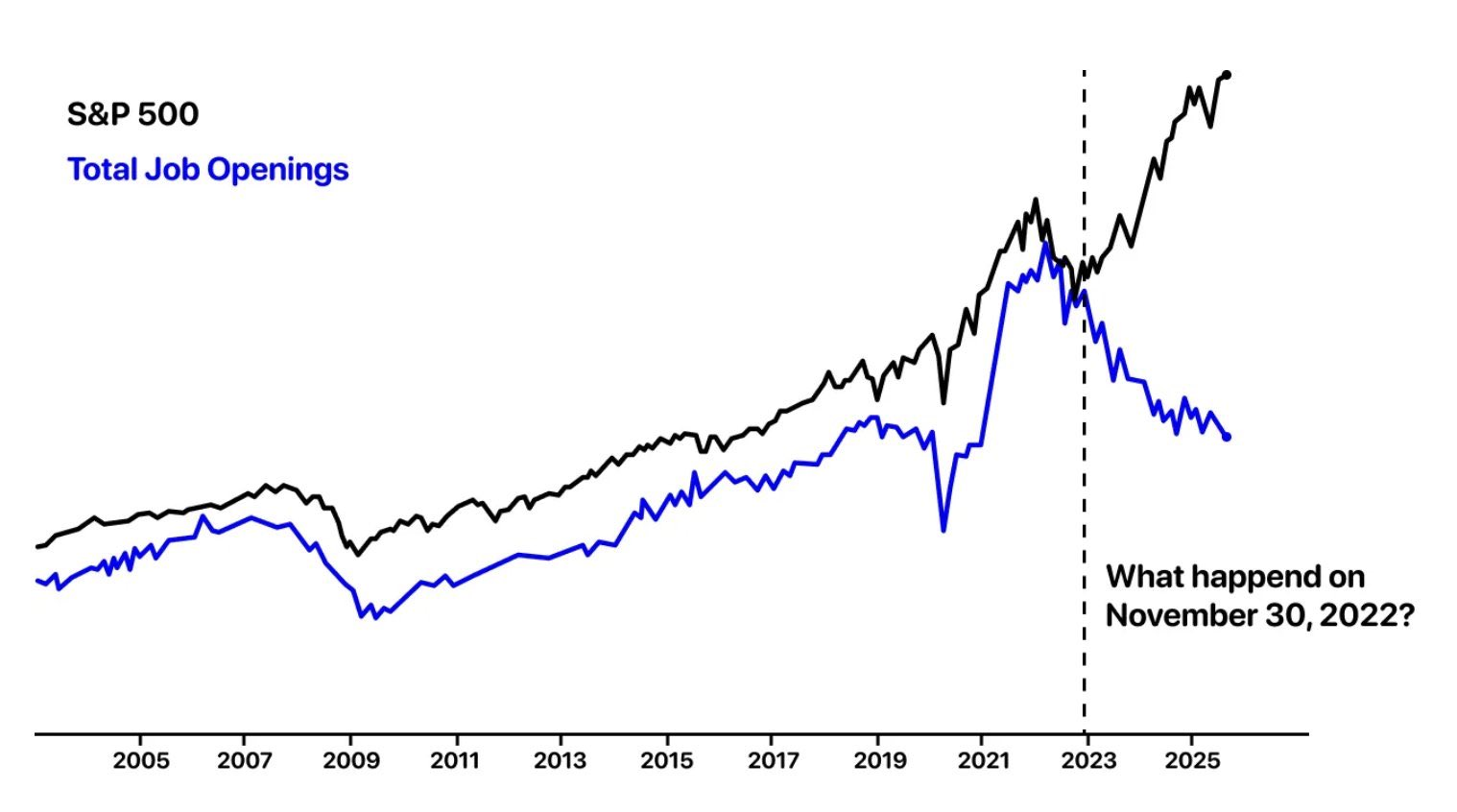
Look at this graph closely. See where they start drifting apart? November 2022.
That's when ChatGPT dropped.
For the first time in two decades, jobs aren't rising when markets are.
Companies are firing people, and the stock market is cheering. The S&P just hit a record high while tens of thousands lose their jobs every month.
That's when I realized: company growth doesn't mean job growth anymore.
This isn't just Amazon. It's everywhere.

Some of the biggest job cuts announced in recent months. • Amazon is cutting up to 30,000 corporate jobs. • Accenture is laying off 11,000 employees. • Target is cutting about 1,000 jobs. • General Motors let go of 200 salaried workers. • Rivian is eliminating 600 jobs.

Just this year, tens of thousands have been laid off across tech and retail. Microsoft, Accenture, PwC, Starbucks, UPS, Nike. The list keeps growing.
Yet the stocks keep going green.
Who Gets Hit Hardest
Here's the painful part: it's not hitting everyone equally.

Pretty interesting: Companies that have adopted AI aren't hiring fewer senior employees, but they have cut back on hiring juniors ones.
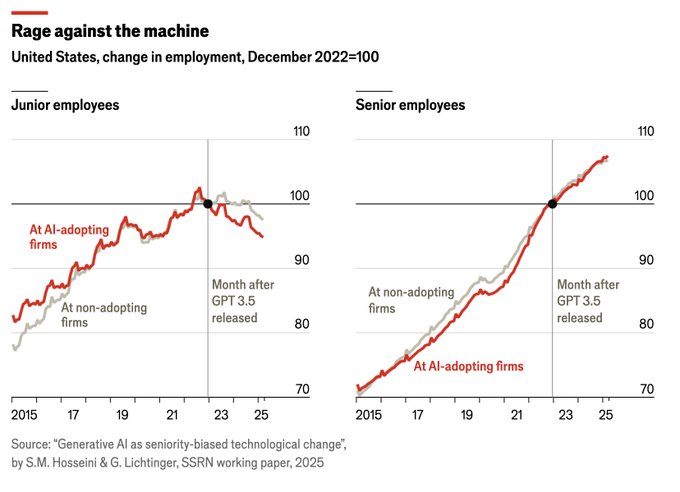
A Harvard study shows junior roles are the first to go. AI-adopting firms are shrinking entry-level positions faster than ever.
The career ladder is breaking from the bottom up. The first few rungs where you learn, where you prove yourself, where you build experience are disappearing.
And it's not just one type of job. Admin, legal, architecture, design, even computer science all sitting near 40% automation risk.
The jobs we thought were "safe" aren't safe anymore.
This isn't the first time technology has disrupted work. We've been through automation waves before. But this one's different:
Speed: Previous waves took decades. AI is moving in years.
Scope: Past automation targeted physical labor. AI is coming for cognitive work.
Bottom-Up Effect: Usually automation replaced lower-skill work first. This time, it's hitting entry-level positions hardest, removing the pathway for people to gain experience.
We're in the disruption phase right now. It's uncomfortable. People are losing jobs, and it sucks.
But history shows we'll adapt. The question is who will be positioned to thrive when we do.
What I'm Actually Doing About It
I'm in my twenties. I have the energy to work nights and weekends. If there's ever a time to go hard, it's now. Here's what I'm actually doing:
1. Work Hard to Be Different
Being "good" isn't enough anymore. When AI can do good work instantly, you need to be remarkable.
I'm focusing on deep expertise in areas AI struggles with (like system design, business context, stakeholder management, unique combinations of skills, and building in public)
2. Stay Updated with Latest Tech
You can't afford to be too busy to learn the technology that might replace you.
I spend time every week playing with new AI tools, following the research, and understanding where the tech is heading.
3. Build Side Projects as Proof of Work
Credentials matter less when everyone has them. What matters is proof you can build things.
That's why I built Gradbro, a graduate school admissions predictor using 250,000+ real application data points. Not because I needed it for my job. Because I wanted to prove I could build something real that helps people.
Side projects show you can ship, you understand real problems, you have discipline to finish things, and you're valuable because of what you've built.
4. Staying Long Is Okay, Staying Stagnant Is Not
Staying at a company is fine if you're growing, learning, and taking on new challenges.
What's not fine is staying comfortable while the world changes around you.
5. Work Nights and Weekends Now
I'm not saying everyone should hustle 24/7. But if you're young, single, and early in your career, this is the time to go hard.
I'm building side projects. I'm creating content. I'm learning skills that compound. The people who will thrive in 10 years are the ones who spent the last few years building when others were coasting.
Amazon layoffs aren’t just about robots in factories, it’s about middle managers and those with rote jobs being replaced with AI faster than we expected NO ONE IS COMING TO HELP YOU — YOU’RE ON YOUR OWN! BECOME A FOUNDER, DO A STARTUP WITH THE SMARTEST TWO PEOPLE YOU KNOW —


told y’all Amazon would replace their employees with robots — and certain folks on the pod laughed & said I was being “hysterical” I wasn’t hysterical, I was right Amazon is gonna replace 600,00 folks according to NYTimes — and that’s a low ball estimate IMO It’s insane to

Jason's right about one thing: no one is coming to save you.
The harsh reality: You're responsible for your own relevance. If you're not actively staying valuable, you're passively becoming replaceable.
I'm not saying work yourself to death or that everyone who loses a job deserved it. I'm saying regardless of whether this is fair, it's happening. You can complain about it or you can prepare for it.
This isn't the end of work. But it is the end of work as we knew it.
Company growth used to require people. Now it requires AI, and people are optional.
The question is: what are you going to do about it?
For me, it's simple: Build things that prove I'm valuable. Stay on top of technology. Create optionality. Work hard while I'm young. Stay aware and adapt continuously.
I think we're in for a rough few years. More layoffs. More uncertainty. But there will also be incredible opportunities for people who are prepared.
If you're thinking about these questions too, I'd love to connect. Follow me on Twitter/X and LinkedIn for more thoughts on AI, startups, and building things that matter.